Showing posts with label juniorcontract. Show all posts

Friday, 7 July 2017

Brexit, junior doctor contracts and the Tory-DUP deal - a perfect storm for junior doctor morale

By MedShr, 2017


With the latest political war over, the dust will now begin to settle, talk will turn back to celebrities and frivolity, and the NHS will continue on its current trajectory with Hunt at the helm. But what does the new government mean for the NHS - and in particular the current state of morale for junior doctors?


The morale of NHS doctors has been a concern for many years, and results from the latest NHS staff survey show that 39% of NHS staff admitted to experiencing work-related stress that made them feel unwell in the last 12 months (NHS Staff Survey, 2016).


Why are junior doctors suffering from low morale?


Let’s start with Brexit. In 2016, 10% of doctors were from elsewhere in the EU according to the English Health Service’s Electronic Staff Record. If Brexit negotiations turn sour, and EU citizens can’t be guaranteed their rights within the UK - or in fact just don’t feel welcome anymore - we would face an NHS staffing crisis amongst doctors. The BMA polled over 1,000 doctors from the EU working in the NHS after the Brexit vote, and found that 42% are thinking of leaving, and a further 23% were unsure (BMA, 2017).


And then there is the 1% pay cap that was introduced by the Conservative government, which means that with inflation, staff are actually getting paid less year-on-year. This is simply an insult to the people we are entrusting to save our lives, and was exacerbated by Theresa May’s unsympathetic comments during the election campaign that there is “no magic money tree.” Real term pay cuts for doctors and nurses are having a direct effect on recruitment and retention across the NHS.


Next is the workforce crisis that is hidden from public view. Already thinly stretched, junior doctors are reporting gaps in rotas and regularly working longer than their allocated hours to protect patient safety and complete essential clinical work. These excessive and often unrealistic workloads, coupled with falling pay, are pushing doctors to leave medicine. The Royal College of Physicians (RCP) even issued a warning at the end of last year that patient safety was seriously compromised by gaps in junior doctor rotas. For example, in paediatrics, the most recent workforce report shows hospitals are currently having to cope with an average junior doctor vacancy rate of 14% and 240 empty consultant posts (Politics, 2017).


And finally, the lack of recognition. Politicians talk about increased spending and promises about recruitment to the NHS, but what we must remember is that these pledges affect real people; people who are doing their best to keep us safe. Junior doctors are at the start of their careers, but face low morale and the risk of burnout from year one, so it’s no wonder they are leaving to work in sunnier climates with better working conditions (BMA, 2016).


What can we do about low morale?


We need to start focusing on the health and wellbeing, both mental and physical, of those who look after ours. Nearly all political parties promised an increase in NHS funding. More resources and increased staffing would mean that junior doctors will feel less stretched, causing less work-related stress and ultimately improving morale - but with an ever-increasing population, is the UK government willing to put up taxes to pay for it? Is the NHS as efficient as it can be, and if not, what streamlining and collaboration can be introduced to improve services and reduce the workload on junior doctors?


The NHS under the Conservative-DUP deal


During their 2017 election campaign, the Conservatives pledged to support GPs in delivering “innovative services that better meet patients’ needs, including phone and online consultations and the use of technology to triage people better and support integrated working.” However, they also want all newly qualified doctors to be forced to work for the NHS for at least four years - a form of indentured labour which is highly unlikely to make doctors feel valued and may exacerbate the antipathy.


Could the Conservatives’ health policies be the reason May failed to gain a majority? And will the DUP block or support the Conservatives in their healthcare plans? In 2016, the DUP released a document that states they believe that the NHS needs to evolve to fit 21st century patients and societal problems, an NHS that is “more efficient, more productive and embraces innovation. One that realises the full potential of our integrated health and social care systems” (DUP, 2016). This could mean that a Tory-DUP deal will attempt to streamline NHS pathways and improve efficiency between primary and secondary care. But is this even possible without a significant increase in funding and resolving the lack of morale that is currently rife amongst overworked junior doctors?


The literature and first-hand anecdotes are out there, and it’s a well-trodden mantra - the NHS is underfunded. Without increased funding, there simply will not be enough staff, and junior doctors will continue to feel overworked and undervalued. And without junior doctors staying to progress within the NHS, there may not be a free NHS forever. Aneurin Bevan – often credited as creating the NHS - said in parliament on February 8th 1948, “take pride…we are still able to do the most civilised thing in the world, put the welfare for the sick in front of every other consideration,” - but perhaps we no longer are.

Tuesday, 13 December 2016

Junior doctors’ strikes: the greatest union failure in a generation

Posted on 8th December by Ahmed Khan

The first wave of junior doctor contract impositions began this week. Here’s how the BMA union failed junior doctors.

In Robert Tressell’s novel, The Ragged-Trousered Philanthropists, the author ridicules the notion of work as a virtuous end per se:

"And when you are all dragging out a miserable existence, gasping for breath or dying for want of air, if one of your number suggests smashing a hole in the side of one of the gasometers, you will all fall upon him in the name of law and order.”

Tressell’s characters are subdued and eroded by the daily disgraces of working life; casualised labour, poor working conditions, debt and poverty.

Although the Junior Doctors’ dispute is a far cry from the Edwardian working-poor, the eruption of fervour from Junior Doctors during the dispute channelled similar overtones of dire working standards, systemic abuse, and a spiralling accrual of discontent at the notion of “noble” work as a reward in itself. 

While the days of union activity precipitating governmental collapse are long over, the BMA (British Medical Association) mandate for industrial action occurred in a favourable context that the trade union movement has not witnessed in decades. 

Not only did members vote overwhelmingly for industrial action with the confidence of a wider public, but as a representative of an ostensibly middle-class profession with an irreplaceable skillset, the BMA had the necessary cultural capital to make its case regularly in media print and TV – a privilege routinely denied to almost all other striking workers.

Even the Labour party, which displays parliamentary reluctance in supporting outright strike action, had key members of the leadership join protests in a spectacle inconceivable just a few years earlier under the leadership of “Red Ed”.

Despite these advantageous circumstances, the first wave of contract impositions began this week. The great failures of the BMA are entirely self-inflicted: its deference to conservative narratives, an overestimation of its own method, and woeful ignorance of the difference between a trade dispute and moralising conundrums.

These right-wing discourses have assumed various metamorphoses, but at their core rest charges of immorality and betrayal – to themselves, to the profession, and ultimately to the country. These narratives have been successfully deployed since as far back as the First World War to delegitimise strikes as immoral and “un-British” – something that has remarkably haunted mainstream left-wing and union politics for over 100 years.

Unfortunately, the BMA has inherited this doubt and suspicion. Tellingly, a direct missive from the state machinery that the BMA was “trying to topple the government” helped reinforce the same historic fears of betrayal and unpatriotic behaviour that somehow crossed a sentient threshold.

Often this led to abstract and cynical theorising such as whether doctors would return to work in the face of fantastical terrorist attacks, distracting the BMA from the trade dispute at hand.

In time, with much complicity from the BMA, direct action is slowly substituted for direct inaction with no real purpose and focus ever-shifting from the contract. The health service is superficially lamented as under-resourced and underfunded, yes, but certainly no serious plan or comment on how political factors and ideologies have contributed to its present condition.

There is little to be said by the BMA for how responsibility for welfare provision lay with government rather than individual doctors; virtually nothing on the role of austerity policies; and total silence on how neoliberal policies act as a system of corporate welfare, eliciting government action when in the direct interests of corporatism.

In place of safeguards demanded by the grassroots, there are instead vague quick-fixes. Indeed, there can be no protections for whistleblowers without recourse to definable and tested legal safeguards. There are limited incentives for compliance by employers because of atomised union representation and there can be no exposure of a failing system when workers are treated as passive objects requiring ever-greater regulation.

In many ways, the BMA exists as the archetypal “union for a union’s sake”, whose material and functional interest is largely self-intuitive. The preservation of the union as an entity is an end in itself.

Addressing conflict in a manner consistent with corporate and business frameworks, there remains at all times overarching emphasis on stability (“the BMA is the only union for doctors”), controlled compromise (“this is the best deal we can get”) and appeasement to “greater” interests (“think of the patients”). These are reiterated even when diametrically opposed to its own members or irrelevant to the trade dispute.

With great chutzpah, the BMA often moves from one impasse to the next, framing defeats as somehow in the interests of the membership. Channels of communication between hierarchy and members remain opaque, allowing decisions such as revocation of the democratic mandate for industrial action to be made with frightening informality.

Pointedly, although the BMA often appears to be doing nothing, the hierarchy is in fact continually defining the scope of choice available to members – silence equals facilitation and de facto acceptance of imposition. You don’t get a sense of cumulative unionism ready to inspire its members towards a swift and decisive victory.

The BMA has woefully wasted the potential for direct action. It has encouraged a passive and pessimistic malaise among its remaining membership and presided over the most spectacular failure of union representation in a generation.

Tuesday, 12 April 2016

How To Solve The Health Crisis. Leave Us Alone.

Posted on 12th April by JuniorDoctorBlog


Dear Messrs Cameron, Osbourne and Hunt,


You may have noticed the NHS is doing pretty badly latelyfunding is at a record low,waiting times are at a record high, and morale across the service is at rock bottom.


You all made some silly promises about money- that’s okay, we all say things we don’t mean sometimes. You perhaps got a little confused and said that you were committing “half a trillion” pounds to the NHS over this parliament- which is simply the current flat yearly budget (~£100 billion) x 5 years. You said this was ‘the most amount of money ever given to the NHS’, but you might remember every successive government since 1948 could have said the sameit’s called health inflation.


You may have forgotten about that when you said you were ‘committing 10 billion‘ pounds ‘extra’ to the NHS, to fund the NHS ‘own’ plan. Except it wasn’t the NHS own plan– it was yours, and it’s not nearly enough even to keep the lights on.


Everyone’s a critic eh? It’s not nice when people say you’ve done a bad job, so I can fully appreciate why you asked hospital accountants to hide the debts under their carpets, and told hospital managers to pay for less nurses and doctors last year. I can feel your annoyance when hospitals decided that wasn’t safe, and had to hire lots more agency staff to fill the gaps. You said some silly things blaming this on agency fees, but that’s okay, 80% of the cost of this was the gaps themselves, and you won’t make that mistake again next time will you? Will you?!


You’ve said some funny things about the health service. You’ve said you want it to be the ‘safest health care system in the world‘, but I think you also want it to be the cheapest in the industrialized world? I picked up a few bits for you to read- might help. This one shows increased funding improved outcomes in healthcare. This one shows big reorganizations in healthcare don’t work at all.


You’ve said some things which, I think, aren’t true. I do hope I’m wrong. You said you were committed to keeping the NHS public – but Virgin just bought huge swathes of services, and private company contracts increased 500% this year. You have neglected to mention this, but that’s okay – government is busy work, and not everything can be in every speech. Some people might not mind NHS privatisation, but I do think you should let them know.


You’ve handled the junior doctor contract rather badly. I don’t think it’s unfair to say so. 98% of ballotted doctors voting for strike action, the first doctors strike since 1970, the first ever emergency walk out in NHS history, record levels of dispersal, record low morale. Can I make some suggestions? Have you thought about just leaving them alone?


Since 2006 they have had a £6000 one off pay cut, then a further cumulative 25% pay loss while working in the busiest and least funded decade in NHS history. But no one really complained, bar a half-hearted effort in 2012. I don’t think this is about money, but understand the context.


Doctors conditions are already poor and retention is already a problem. Record levels of doctors leave training after two years, vacancies and rota gaps have increased 60% in two years, and 1/3 GP training posts and  50% of year 3/4 A&E registrars resigning.


So what’s the hurry? Do correct me if I’m wrong, but if contract changes are cost neutral, but could threaten recruitment and retention of staff at a time when the NHS is under incredible pressure, and doctors say is categorically less safe than current conditions, one has to ask, why bother? Why not talk for another year, rather than strikes and strikes, and resignations. Not to mention the reversal of all equality workplace gains in the last decade. Mr Hunt wanted ‘certainty’ in the health service- but I cannot imagine a more uncertain time.


Why not just leave us alone? It’s not too wild an idea. You might say the BMA asked for contract negotiations and therefore the contract must change. This is like inviting your friend for tea, punching them in the face repeatedly and then wondering why they wanted to leave. You can’t force them to keep having tea at your house, and if tea isn’t essential, then why would you?


It might hurt your feelings a little bit, but that’s okay. We all have little tiffs, we all make mistakes. No need to be too proud about it. After all, why would you want to wreck a whole health service just to save face?


It must be a tricky job, being in charge of everything. Why don’t we just sit and talk for a bit, about how we might all make the NHS better?


Unless of course that’s not what you want at all. Unless you have decided that with four years of government, a weak opposition, and deep pockets controlling >50% media and the BBC, you might decide to ram through as much toxic and undemocratic policy as you possibly can. Kamikaze politics, with a hope some strong PR spin at the end will still save the next election? So why not ram through massive NHS-reorganisation and sell offprivatise the schools and the land registrycut disability benefits and cut corporate tax, cut funding to the opposing party and turn the BBC into state-run television. Why not in fact trample the entire fabric of democracy, safe in the knowledge that the public are too apathetic to offer any significant opposition?


You are leaving them few choices Messrs Cameron, Osbourne and Hunt. Strike or resign. Perhaps it’s #timetolisten? Or better yet, just leave them alone.
Juniordoctorblog.com

Sunday, 10 April 2016

Dear Other Normal Human Beings

Posted on 6th April by JuniorDoctorBlog


As relevant today as it was 9 months ago…

Dear Other Normal Human Beings,

I am writing to you, because, like myself, you are a normal human being.

You, like me, wake up in the morning and sleep at night, eat meals, sometimes with loved ones, sometimes alone. We are alike in our requirement for other people, for happiness, for security, for food, for warmth, for shelter.

You may have children, you may have brothers or sisters. You have, or had, parents, and perhaps were lucky enough to know your grandparents.

You may have noticed that many health professionals are becoming uncharacteristically vocal. You may have thought them self-serving, morally bankrupt individuals, upset over their own pay packets.

I would like to explain to you, from one normal human being to another, what is going on.

I am a doctor. I decided to be a doctor before I really knew what decisions were, and can never remember wanting to do anything else. Once I knew how, I found the path, and worked my arse off. Six years, in secondary school, studying. Two years, in college, studying. I took four A-levels, I had 25% less free time than my friends, and when they were out, doing whatever they wanted, I was not. I was studying. Another six years at medical school, studying, and sometimes working to pay for the studying. The last three years of medical school I worked harder than I ever had, and the same hours as a full-time professional, sometimes way more. It even made me sick- in my final year I developed acute gastrointestinal bleeding. But, becoming a doctor was all that meant anything to me. So, I took my top grades and turned them in, in return I got fourteen years hard graft, and £50,000 worth of debt. [2]

Why is this important? Because, from the very beginning, I knew about sacrifices. As thousands of my colleagues have, as millions before me have, and millions will. I knew about sacrifice when I worked for a year before university, so I could afford the rent, when I missed my first family Christmas to work as a warden in student halls, so I could afford to stay at medical school. I knew about sacrifice when I missed nearly every other Christmas since, working, or sometimes studying. I knew about sacrifice when I’ve missed my friends weddings, my nieces and nephews birthdays, when everyone I knew was travelling, and I was studying, or working. Being a doctor, and it’s inherent position in society and in the hearts of the public, is irrevocably tied to sacrifice- it’s the dedication it takes to become, and to stay, a doctor, that by definition requires sacrifices to time, to personal satisfaction. All over the country right now, doctors and nurses, physiotherapists and occupational therapists, radiographers and ward clerks and all the other medical professionals are sacrificing their lives, minute by minute, to try to give you or your loved ones minutes, hours, days or years more. So, when, as a normal person, someone tells you doctors don’t understand ‘vocation’, you know now- it is beat into us before we even get through the door.

But, as a normal person, of course you understand why doctors would defend the NHS, would fight to protect it, and so vociferously attack it’s detractors. They have a vested interest, they want to keep their cushy salaries and great jobs, and the NHS is great for that.

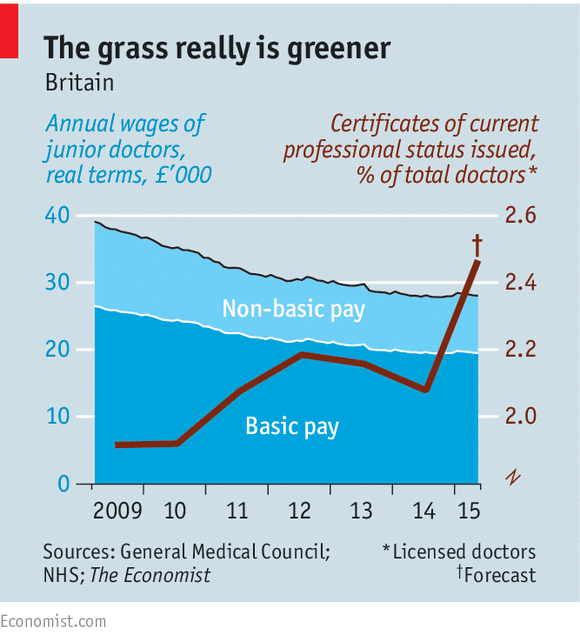
Let me tell you straight: if I didn’t care about you, or my patients, I would be out there campaigning to close the NHS right now. I would make more money in the private sector in a day than I would in two weeks of NHS work. I could also take my UK Medical degree, one of the most respected qualifications anywhere in the world, and go and earn 50-200% more in the US, Australia, New Zealand [3]. In the private sector, if I stayed after 5pm to look after you, the next thing you see after my smiling face as you exit the hospital, will be the bill on the doormat; ‘overtime’, ‘time in lieu’, ‘additional hours rates’ aplenty.

But, I, like you, have a family. I went to state school, and worked and grafted to pay for my six years at University. Without the NHS my grandmother would have gone blind, my father would have had several heart attacks, my mother would have died. I might have died. A private system would’ve bankrupted them, ended their hopes for a better future in order to pay to survive. I, like you, would do anything for the ones I love, and that is why I campaign to protect and improve the NHS. And that is why, when 5pm comes and goes, as does 6pm, 7pm and all the other hours in between, I, and every colleague I have ever worked with, stays for their sick patient. Because, one day, somewhere, for someone else, that patient will be their mum, or dad, wife or husband, son or daughter.

We have had, and always have had, the extraordinary privilege of one of the greatest healthcare systems, pound-for-pound, in the world. The reasons for it’s great outcomes and low cost are debatable. But there are some reasons we never mention. This country has a medical school system of international renown, whose doctors, for the most part, qualify and stay exclusively working within the NHS. The staff of the NHS gives untold free hours to the profession; when I was a first-year junior doctor, I calculated I worked one day at work for £4.10 an hour. I used to get paid more at Tescos. But a very sick patient needed a lot of complex care, and so I stayed, and helped, and he survived: as millions of patients have since 1948. [4]


The moves of the current government against the medical profession are calculated: to deride working conditions, salaries, hours and deplete hospital resources, until a normal person, like myself, buckles under the social, financial and emotional cost. At that point, a sea-change of new, private hospitals will open, and we will go and work there. And our lives will be pretty much the same- different bosses, the same bureaucracy and probably better pay. But our lives, as normal people, will not. You will still pay taxes, a stripped-down NHS will persist, for no frills, emergency care only, but not for all the other healthcare needs of a 21st century population: you will need private healthcare. And that healthcare insurance will cost you hundreds of pounds a year, if not a month. And if you don’t have insurance, you will spend thousands of pounds on the simplest, quickest procedure [5]. And the NHS won’t be there for my family, or the families of normal people across the country.

So, I want this to reach as many normal people as it can. If you don’t act now, it will be too late. It might already be too late.

We care deeply because we can see the great good the NHS does, every single day. And I care because, like you, I care about the ones I love.

Where can you start?

Here might be a good place:

Www.crowdjustice.co.uk/case/NHS

We are taking the government to court, to show us they aren’t gambling the future of the health service away on an unmodelled and unsafe contract.

If you want an NHS at all it’s time to help.

Yours sincerely,
juniordoctorblog.com


[PART 2: A Factual Appendix]
-What normal people appreciate, are hard, solid, unflinching, facts. So here they are.

[2] Medical students studying now can now expect to pay £9000 pay a year as of 2015 for six years for most courses: that is £54,000. Most will require a student loan to pay living expenses for a full time course, at a further £5000 a year that totals £79,000 for six years study. Maintenance grants for the poorest students have been scrapped, adding an additional £10,000 debt as a minimum.

[3] Starting pay for any consultant in the UK : £75, 249. In the US: £111,799.80 for internal medicine, £183,152.91 for a radiologist. ($/GBP rate correct at time of writing). In Australia: a basic salary of £78,000 for internal medicine consultants, BUT this is for a 38 hour working week. Average overtime and up-scale pay between £92,526.97- £244,366.10. Same with New Zealand for a 40-hour week, after average overtime and up-scale up to £128,039.69.
UK data: http://bma.org.uk/practical-support-at-work/pay-fees-allowances/pay-scales/consultants-england

US data:http://www.payscale.com/research/US/People_with_Jobs_as_Physicians_%2F_Doctors/Salary.

Australian data: http://www.imrmedical.com/australia-salaries-tax

New Zealand data: http://www.imrmedical.com/new-zealand-salaries-tax

[4] The NHS opened it’s doors, metaphorically, July 5th 1948. It’s first patient was a 12-year old girl with a liver condition. http://www.legislation.gov.uk/ukpga/Geo6/11-12/29

[5] This is incredibly interesting reading, although it is for claims, it is still very reflective of the actual cost. https://www.freedomhealthinsurance.co.uk/downloads/your-choice-procedure-payment-guide

Wednesday, 16 March 2016

The Government Aren't Listening. Time To Make Them.

Posted on 13th March by JuniorDoctorBlog


junior-doctors-jeremy-hunt-court-funds-strike-contact.jpg


The junior doctor contract dispute has taken its toll; eight gruelling months, three major protests, four days of strike action, and 54,000 angry, articulate, dedicated individuals.


We have staged sit insdelivered giant booksset up fake betting shops, supported two hugely successful choirs and one Christmas number onecreated fashion lines, and even collaborated with a Time Lord or two. We have become our own investigative journalists: uncovering dubious research practice, revealing departmental incompetence and lies, and documenting tragic cases of the government’s spin causing real patient harm. We have become our own researchers: revealing flawed datamisrepresentation of statistics and huge holes in the government’s ‘evidence’ arguments. 
We are not giving up anytime soon.


Why are we doing this? David Cameron and company would have you believe we are grabbing for a payrise, grabbing for free weekends and better perks. Many of you know by now this is simply untrue.


What we are terrified of is an imposed contract, unmodelled, uncosted, and unbelievably unsafe. The NHS is on its knees- the knock-on effect to recruitment and retention alone, not just for junior doctors but all NHS staff, could collapse the entire service.


So what next? How can we make a government listen to our concerns.


This. We, a group of patients, doctors and NHS staff, are proud to announce the initiation of a second independent judicial review into the junior doctors contract. We are not the BMA- they have challenged the government as an employment dispute, on equality grounds.


We are challenging them over patient safety- patients who are concerned an already underfunded NHS cannot cope with the government’s insistence on ‘7-day’ services without additional funds or additional doctors. We have huge gaps in cover already-60% increase in rota gaps for doctors, 50% increase in agency nurses in a single year9/10 junior doctors have said they will resign if the new contract goes ahead. Even if 1/10 actually leave- for locum work, abroad, pharmaceuticals, or even simply stop being doctors- the system will crumble. Then the nurses, the pharmacists, the AHPs, the consultants, the GPs will undergo the same.


We have instructed renowned Human Rights and judicial review specialist law firm, Bindmans LLP, to investigate the legality of the decisions of the Secretary for Health. We will ask for a wide-ranging review into the impact on staffing, costing and the evidence for need and benefit of imposition. We will force the government to finally listen, and come up with the so-far missing evidence to back up months of wild claims and false promises.
At the very least we will see the necessity, and take the time to consider the biggest gamble in the history of the NHS. At best, we may finally prove that the DoH and government have been peddling smoke and mirrors, and find the real reasons for the underfunding, the enforced contracts, the increased privatisation. Most importantly, we may avert catastrophic patient harm.


What can you do to help?


We are not an organisation- we are simply individuals who care deeply about the future of the NHS. We are crowdfunding our case here, at CrowdJustice. Follow us on Twitter and Facebook as #JustHealth. We are off to a great start, but need at least £100,000 or more to fund such a complex and important legal action. We will possibly need more to keep going, and it will be only your support that will make this possible.
For years I have ranted on about trying to save our NHS. Many of you agree, but ask “what can I do about it?”
This. You can do this.


We can save our NHS. We must.


Juniordoctorblog.com


Saturday, 20 February 2016

NHS Morale Should Be Our Biggest Priority

Posted on February 13th by Dr Gagan Bhatnagar on the clinoncdoc.


The Government has bulldozed ahead with the imposition of a junior doctor contract against the advice of every professional medical body in England. Of the 20 NHS chief executives that supposedly backed his imposition, 14 have stated that they in no way supported this extreme action. It is worth considering that if the Government can just impose a contract of their own accord without agreement of the other party, what is to stop them from changing their mind in the future only to impose another contract?


The crux of the contract debacle is simple, the Government and NHS Employers are looking to extend services to 7 days on a 5 day (elective care) budget. Emergency care already runs 7 days a week, 365 days a year. Mr Hunt is not proposing to increase the pool of doctors to achieve this, so he will be stretching an already over-stretched workforce more, for the same pay-packet. The simple solution: If you would like to extend services, fund and staff them appropriately. Indeed experts suggest an extra 38,000 doctors would be required to safely staff a 7-day NHS.


This debacle comes on the back of a build up of frustration within the NHS workforce over a number of years. Increasing demands, real term pay-cuts for over a decade (ignoring DDRB advice for annual pay rises with inflation), staffing shortages, no recognition of the need for rest and breaks, and no support for those in training has left junior doctors (and other healthcare workers) at breaking point. The workforce now feels under-valued and demoralised. The dissent that followed asking doctors to do more for less, was inevitable.


Senior officials within the NHS have acknowledged the demoralisation of the workforce over a number of years. I place the blame, not only with the Government, but NHS Employers. They are directly responsible for looking after their work-force, but in the pursuit of appeasing a relentless Government hell-bent on ‘efficiency savings’ and ‘extension of services’ without extra funding, they have failed their employees. Employers have failed to listen to junior doctors and have failed to engage them, all the while increasing their requirement for service provision and depleting their training time. Doctors are expected to train in the little free time they do have (often coming in on their days off, just to gain experience), pay exorbitant fees for mandatory exams, courses, and medical licenses for the benefit of the Trust and patients.


The same can be said for nurses that are ever being stretched thinner due to cost-cutting. Recent studies show that mortality was significantly improved when nurses are responsible for 6 or fewer patients. However, this is rarely the case in most hospitals. Indeed recently the Government attempted to bury safe-staffing guidelines. The Government and NHS employers are hardly champions of patient safety.


It is little surprise then. As working conditions and morale have deteriorated over the last decade, the medical profession has found itself in a serious recruitment crisis. In recent years, one third of A&E doctors have left. Last year half of Foundation Doctors did not apply to specialty, a drop of some 25% from a few years prior. Across the board, fewer doctors are choosing to continue their training in the NHS due to poor working conditions. Even more worrying is a drop in medical school applications by 13.5% since 2013 which has been linked to the continuous negative publicity.  These numbers are catastrophic.


In a capitalist society where value is measured in coin, pay is certainly part of the issue. It is worth clarifying that junior doctors have never asked for a pay-rise. The government justifies huge bonuses for bankers and chief executives to recruit and retain the best but the same does not apply for doctors, nurses, or teachers. Fundamentally, this debacle is about feeling valued and respected and thereby retaining your doctors to provide the best care possible. The persistent devaluing of bright, highly skilled and motivated staff over a number of years has lead to this crisis which will ultimately be to the detriment of patients.


Unfortunately the actions and words of the Health Secretary have not helped morale which has received severe backlash on social media. Mr Hunt has called doctors militant and lacking in vocation (#MilitantMedic, #LackingInVocation). He has suggested junior doctors don’t work weekends (#ImInWorkJeremy). He has claimed our motivations are monetary (#DangerMoney). He is closely linked with the smear campaign by Murdoch media (#MoetMedics). He has continuously lied and misrepresented scientific data, and when answers are demanded of him, he shirks his duties by failing to attend urgent questions in parliament (#TheJeremyHunt, #TheHuntHunt).


Mr Hunt has failed to meet face to face with a junior doctor in over a year, and has been caught on camera actively running away from a junior doctor on Sky TV. Furthermore, he has cancelled meetings with the public for fear of confronting a doctor. If his actions were right, he should have no difficulty justifying them to doctors face to face. This is not a Secretary of State that instils confidence or boosts morale. As the single biggest contributor to loss of morale in recent history, there was a distinct irony when Mr Hunt requested an inquiry into why doctors’ morale is so low.


Morale may seem an abstract concept to measure, but it is clear that it has never been lower in the NHS. As it continues to plummet in the face of contract imposition, doctors may vote with their feet, leaving the NHS in further turmoil. Improving the morale of staff should be the single most important item on the itinerary for NHS Employers, and they should begin by stopping the meaningless lip-service and demanding the Government retract this imposition and find a way to demonstrate how they truly value their doctors.


Dr. Gagan Bhatnagar MBBS BSc (Hons) MRCP

Clinical Oncology Registrar in Oxfor